Healing Fields
Bringing healthcare to 10 million people across rural India — powered by 8,000 Community Health Entrepreneurs already collecting health data, facilitating telehealth, and conducting screenings in 8,000+ villages.
EP3’s privacy infrastructure protects that data while unlocking its potential for research, population health, and coordinated care.
Healing Fields Foundation
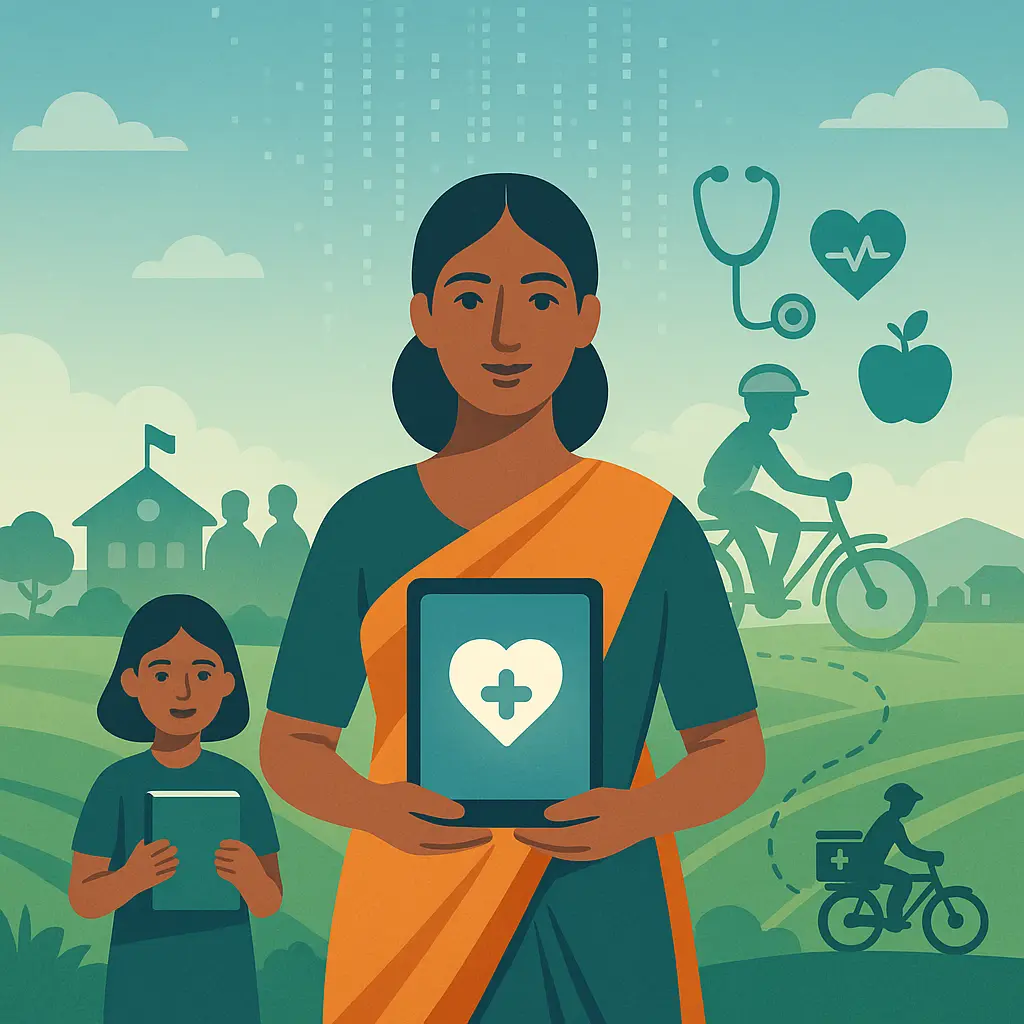
Healing Fields Foundation (HFF) is an Ashoka Fellow-led NGO founded by Mukti Bosco, recipient of the 2022 Roux Prize. HFF trains rural women from resource-poor communities as Community Health Entrepreneurs (CHEs) — health change agents who bring preventive care, first aid, telehealth, and health education directly to families in remote villages where the nearest health center can be 10 kilometers away.
Today, more than 8,000 CHEs serve 10 million people across 8,000 villages in 10 Indian states. They facilitate telehealth consultations, conduct health screenings, navigate government health entitlements, sell essential health products, and collect health data using digital tools. Their work is evidence-based, data-driven, and supported by the Gates Foundation.
Why Privacy Matters for Rural Healthcare
CHEs collect sensitive health data from some of India’s most vulnerable populations — women, children, and families in resource-poor communities. That data has enormous value: it could drive population health research, improve care coordination across districts, and help government programs reach the people who need them most.
But without privacy infrastructure, using that data means exposing it. Rural families who trust their CHE with personal health information didn’t consent to that information reaching researchers, insurers, or government databases with their identity attached.
Privacy Networks solve this. Health data collected by CHEs can be aggregated, analyzed, and used for research and care coordination — without individual families being identified. The community gets the benefit of data-driven healthcare. The families keep their privacy.
What This Looks Like in Practice
A CHE in a village in Telangana conducts a diabetes screening for 200 women. The results are captured on her digital tablet and encrypted into the Privacy Network. Researchers at a university in Hyderabad can analyze diabetes prevalence patterns across 500 villages — by age, geography, and risk factors — without ever seeing an individual woman’s name, location, or health record. The state health department can target intervention programs to the districts with highest need. The women who were screened remain anonymous throughout.
This is the model: community-level data collection, population-level insight, individual-level privacy.
Part of a Global Healthcare Network
Healing Fields brings EP3’s privacy-preserving healthcare model to rural India — complementing the Lōkahi Healthcare Accelerator, which is building the same infrastructure for Hawaii’s health system. The shared technology foundation means that approaches proven in one context can be adapted to the other: population health analytics, privacy-preserving telehealth, coordinated care across providers — all built on the same Privacy Network architecture.
Get Involved
Healthcare organizations, NGOs, public health researchers, government health agencies, telehealth providers, and digital health innovators — help extend privacy-preserving healthcare to the communities that need it most.
Two ways to participate. Apply to join the Accelerator to support privacy-preserving health data collection at community scale, enable population health research without compromising individual privacy, and build telehealth and care coordination for underserved communities. Or record your contributions through QPN Catalyst — no signup required.